Voice Search Optimisation
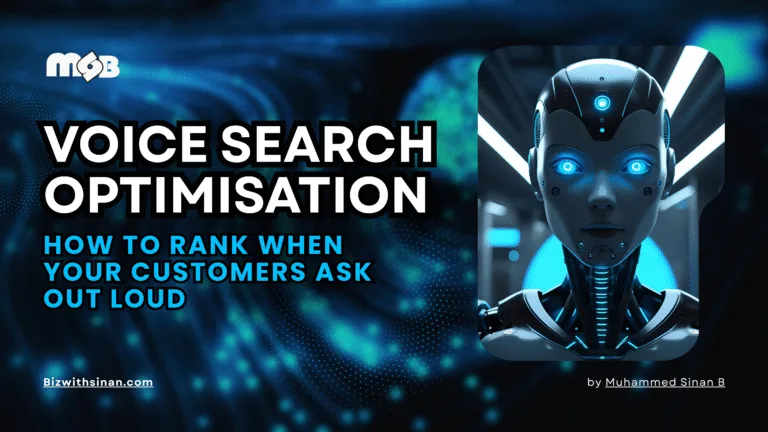
How to Rank When Your Customers Ask Out Loud
Ever noticed how more people are talking to their devices instead of typing?
“Hey Google, where’s the best digital marketer near me?”
That simple voice command is now shaping the future of SEO.
I’m Muhammed Sinan, a digital marketing freelancer from Kannur and I’ve been closely watching how voice search is rewriting the rules of online visibility. In this blog, I’ll break down what Voice Search Optimisation (VSO) really means, why it matters more than ever, and how to future proof your content to win this growing space.
Why Voice Search Isn’t Just a Trend It’s the New Normal
According to Google, over 27% of the global online population uses voice search on mobile. And with smart assistants embedded in homes, cars, TVs, and even fridges, your next customer might find you without ever typing a word.
Voice search queries are longer, more conversational, and often location based. Instead of “freelance marketer Kannur,” people now ask,
 “Who’s the best freelance digital marketing expert near me?” (psst….its me😉)
If your content isn’t optimised to answer how people speak, you’re not even in the race.
Key Shifts in SEO for Voice Search
Here’s what separates voice optimised content from the traditional kind:
1. Natural Language Tone
Write like you’re speaking to a human, not a search engine.
2. Answer Based Content
Most voice searches are questions. Your content needs to answer them clearly and quickly.
3. Featured Snippets Are Gold
Voice assistants often read out the featured snippet result. Structuring your content to land there is the real SEO win.
4. Mobile + Local Optimisation
Voice searches are heavily mobile and location driven. If you’re a business or freelancer in a local market, this is your chance.
How to Optimise for Voice Search (Step-by-Step)
1. Focus on Long Tail Keywords
Use tools like AlsoAsked or AnswerThePublic to find common question style searches in your niche. Include phrases like:
• “How can I grow my business through digital marketing?”
• “What does a freelance marketer do?”
• “Who is the best digital marketer in Kannur?”
2. Use Question Based Headers (H2/H3s)
This helps Google understand and extract your answers.
Example: H2: How Can Voice Search Help Small Businesses?
3. Include a Direct, Concise Answer Early
Under 30 words. Clear. Google loves that.
“Voice search helps small businesses rank better locally by matching spoken queries to optimised content that answers customer questions.”
4. Add Structured Data (Schema)
Use FAQ or HowTo schema to boost your chances of becoming a featured snippet.
5. Improve Page Speed & Mobile UX
Because voice searches come mostly from mobile, your site needs to load fast. Google’s Core Web Vitals matter more than ever here.
to check this visit Google search console, then head over to Core web vitals. (for this you need to connect your website with google search console first).
if you have not connected your website with google click here to know how
Voice Search and the Future of Digital Marketing
Voice search isn’t replacing SEO, it’s evolving it.
It’s forcing marketers to think human first, not keyword first.
If you’re a business owner, adapting now means higher visibility later.
If you’re a freelancer like me, helping clients pivot to this model is a huge edge.
Real World Application: My Approach
As someone building a personal brand and helping clients through BizWithSinan, I’m already integrating VSO in blogs, landing pages, and ad copies. This shift is not just technical, it’s strategic.
I structure content to sound like answers.
I use location cues like “near me” and “in Kannur.”
And I always test my copy using voice queries before finalizing.
These are the micro-optimisations that make macro differences.
Lastly,
Voice search isn’t just a tool, it’s a behavioural shift.
The brands that get found in this new landscape will be those that speak their audience’s language, literally! If you’re a marketer, creator, or small business owner, the time to adapt is now.
Your future customer might already be asking for you aloud.
Want to know how to make your content voice search ready?
Let’s connect on Instagram or LinkedIn or visit BizWithSinan.com for tailored strategies.